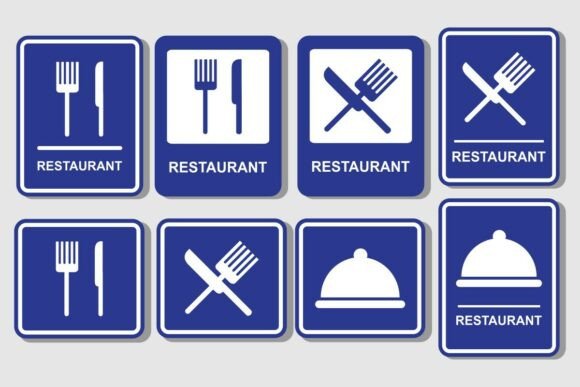
Restaurant Signage Elements Collection: Designing Clarity in Modern Hospitality
Clarity isn’t just a design goal—it’s a functional necessity in today’s hospitality landscape. Whether guiding a guest through a bustling food court, signaling restroom locations in a high-traffic café, or indicating reserved seating on a digital floor plan, visual communication must be immediate, intuitive, and universally legible. Enter the Restaurant Signage Elements Collection: a purpose-built, professionally curated set of vector-based public information stickers and label illustrations designed specifically for dining environments.
A Unified Language for Food-Focused Spaces
The Restaurant Signage Elements Collection is more than a toolkit—it’s a visual language engineered for coherence. Comprising over 60 scalable, flat-style vector symbols—including entrance/exit markers, dining area identifiers, takeaway icons, reservation indicators, restroom signage, directional arrows, and food court zone labels—the collection delivers consistency where fragmentation once reigned. Each element follows strict design principles: clean lines, uncluttered shapes, high-contrast solid colors, and intentional negative space. There are no gradients, shadows, or decorative flourishes—only clarity, scalability, and semantic precision.
What sets this collection apart is its contextual intelligence. Unlike generic icon libraries, every symbol reflects real-world operational nuance. A “reservation required” badge doesn’t just display a calendar—it integrates subtle cues like a checkmark inside a plate outline. A “takeaway” icon pairs a paper bag with an upward arrow, suggesting both portability and speed. Even directional arrows include variants calibrated for indoor flow: gentle curves for corridor transitions, sharp angles for stairwell guidance, and double-ended versions for bidirectional walkways. This level of intentionality bridges graphic design and spatial experience.
Meeting Evolving Expectations in Physical + Digital Environments
Today’s consumers navigate hybrid experiences—stepping from a mobile app reservation into a physical venue, then scanning a QR code for the menu before exiting via a contactless pathway. Signage can no longer exist in isolation. It must function seamlessly across print, screen, and environmental applications—and adapt to shifting behavioral norms.
Consider accessibility: With rising awareness around inclusive design, standardized symbols reduce cognitive load for neurodiverse guests, non-native speakers, and aging patrons. The Restaurant Signage Elements Collection Public Information Stickers Label Vector Illustration supports this by adhering to ISO 7001 principles (public information symbols) while refining them for food-service specificity—such as differentiating “staff-only” zones from “guest pickup” counters using distinct color coding and iconography.
Then there’s operational agility. Cafés pivot between dine-in, takeaway, and delivery models weekly. Malls refresh food court tenants seasonally. Hotels reconfigure banquet spaces for hybrid events. In each case, signage must be updated rapidly—without redesign fees or vendor delays. Because the collection ships in SVG and EPS formats only, designers and operators retain full editability: change a color palette in seconds, resize for a 4K kiosk display or a 2-inch tabletop tent card, or recolor icons to match seasonal branding—all without pixelation or quality loss.
Beyond Aesthetics: How This Collection Aligns with Industry Shifts
This isn’t just about prettier signs. The Restaurant Signage Elements Collection responds directly to three converging industry movements:
- Standardization meets localization: Global chains need brand-consistent signage across markets—but also flexibility to reflect local regulations (e.g., bilingual restroom labels in Canada or EU accessibility mandates). The collection’s modular structure allows teams to assemble region-specific kits from a shared source library, accelerating compliance and reducing translation overhead.
- Speed-to-deployment in experiential retail: Shopping malls and mixed-use developments now treat food courts as experiential anchors—not afterthoughts. When a new tenant opens in under 10 days, signage must be production-ready on day one. Pre-vetted, print-and-go vectors cut approval cycles by up to 70% compared to custom illustration workflows.
- Design democratization for non-designers: Entrepreneurs launching pop-up cafés or cloud kitchens rarely hire full-time designers. Yet they still need professional-grade assets. This collection empowers marketers, operations managers, and even franchisees to build cohesive wayfinding systems using familiar tools like Figma, Adobe Illustrator, or Canva—no vector expertise required.
Real-World Integration: From Concept to Customer Journey
Practical adoption reveals deeper value. Take a boutique hotel integrating a rooftop restaurant and ground-floor café. Using the Restaurant Signage Elements Collection, their team built:
- A responsive web map showing live table availability—where reservation icons dynamically shift from gray (unavailable) to teal (booked) based on API data;
- Wayfinding decals applied directly to elevator doors and hallway walls, using directional arrows paired with miniature food court logos for intuitive orientation;
- Digital menu boards featuring “gluten-free” and “vegan” badges pulled directly from the collection’s dietary labeling subset—ensuring icon consistency across all touchpoints;
- Takeaway packaging stickers printed on biodegradable stock, with the same “grab & go” icon used online and in-store—reinforcing brand trust through repetition.
In each case, the vector foundation enabled reuse without reinterpretation. No redrawing. No style-guide arbitration. Just coordinated, confident communication.
Tech-Forward, Human-Centered
As AR navigation, smart building sensors, and AI-powered wayfinding mature, foundational assets remain critical. You can’t layer dynamic functionality onto ambiguous visuals. The Restaurant Signage Elements Collection Public Information Stickers Label Vector Illustration anticipates this by prioritizing machine-readability alongside human intuition: crisp edges support OCR accuracy; consistent stroke weights aid icon recognition in low-light environments; and logical naming conventions (e.g., restroom-female-solid.svg) streamline integration into CMS or digital signage platforms.
Yet its greatest strength remains profoundly human: reducing friction. A first-time visitor shouldn’t pause to decode a symbol. A delivery rider shouldn’t circle a mall searching for pickup. An elderly guest shouldn’t hesitate before entering a restroom labeled with unclear iconography. This collection treats clarity not as a bonus—but as infrastructure.
Who Benefits—and Why Now?
Freelance designers building brand guidelines for emerging food brands find immediate utility—replacing hours of custom icon ideation with production-ready, legally safe assets. Marketing directors at regional restaurant groups use it to unify signage across 30+ locations without sacrificing local flavor. App developers embedding indoor maps into reservation platforms rely on its precise geometry for accurate spatial anchoring. Even municipal planners specifying wayfinding for public market halls cite its compliance-ready structure as a time-saving benchmark.
The timing matters. Post-pandemic recovery has intensified scrutiny on operational efficiency, hygiene transparency, and guest autonomy. Meanwhile, sustainability mandates push venues toward reusable, digitally managed signage systems—reducing printed waste and enabling rapid content updates. The Restaurant Signage Elements Collection sits squarely at that intersection: efficient, ethical, and engineered for longevity.
Looking Ahead—Without Speculation
Future iterations of hospitality signage won’t abandon simplicity—they’ll deepen it. Expect tighter integration with real-time data, greater emphasis on multilingual and multimodal (e.g., tactile + visual) accessibility, and expanded symbol sets for emerging service models like robotic delivery lanes or temperature-controlled pickup lockers. What won’t change is the foundational requirement: instant recognition, zero ambiguity, universal relevance.
The Restaurant Signage Elements Collection doesn’t chase trends. It enables them—by providing the clear, consistent, and customizable visual bedrock that modern food-service communication demands. For professionals shaping how people move, choose, and feel within dining spaces, it’s not just another asset pack. It’s infrastructure made visible.