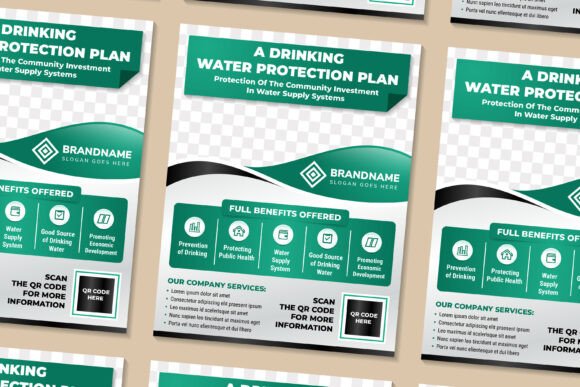
Drinking Water Vertical Flyer: A Practical Design Asset for Public Health Campaigns
The Drinking Water Vertical Flyer is a purpose-built, high-resolution design template intended for organizations and communicators focused on water safety, sustainability, and public health outreach. Unlike generic flyer templates, this asset is engineered specifically for vertical banner use—ideal for placement in community centers, clinics, schools, municipal buildings, and wellness fairs. Its structure supports clear visual hierarchy, prioritizing legibility and message retention in environments where viewers have limited time and attention.
Design Integrity Meets Functional Clarity
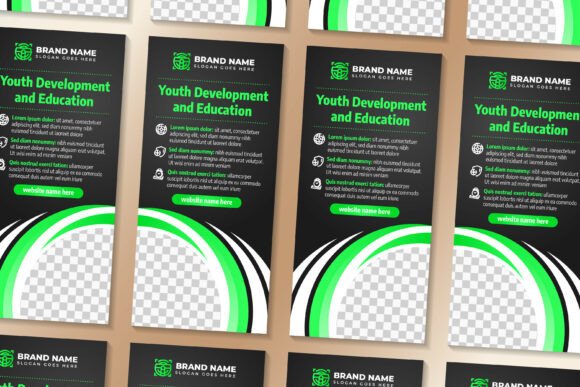
At its core, the Drinking Water Vertical Flyer balances aesthetic restraint with strategic information architecture. The green-and-black color scheme isn’t merely stylistic—it aligns with widely recognized environmental and health communication conventions. Green signals safety, renewal, and natural purity; black provides contrast, authority, and readability. These elements sit cleanly against a subtle white-to-light-grey gradient background, reducing visual fatigue while maintaining professional polish.
The layout reserves dedicated zones: a top photo space (optimized for high-impact imagery of clean water sources, filtration systems, or diverse communities accessing safe water), a central infographic area (suitable for illustrating purification steps, contamination risks, or refill station usage flow), and clearly segmented text blocks for headlines, statistics, and calls to action. This intentional zoning helps designers avoid clutter—a common pitfall in public-facing health materials.
Production Quality That Supports Real-World Use
All graphics are 100% vector-based, meaning they scale flawlessly from small handouts to large-format banners without pixelation or loss of fidelity. At 300 DPI, the included JPG and SVG exports meet print-ready standards for professional signage, while the AI and EPS files preserve full editability for Adobe Illustrator users. Text remains fully editable—not outlined—so localization, branding adjustments, or content updates require no redesign effort.
Layers are logically grouped and labeled within the source files. For example, “Infographic Elements,” “Photo Mask,” and “Footer CTA” are distinct, making collaboration or handoff to a designer straightforward. This level of organization reflects experience with real-world production workflows—not just theoretical design.
Who Benefits—and How
Professionals managing local water initiatives—such as municipal utility staff, nonprofit program coordinators, or environmental educators—will find the Drinking Water Vertical Flyer especially valuable when launching or reinforcing a purified water refill station campaign. Its vertical orientation suits wall-mounted displays near dispensers, lobby kiosks, or transit hubs where horizontal space is constrained but vertical real estate is abundant.
Small business owners operating eco-conscious cafes, gyms, or co-working spaces can adapt it quickly to promote on-site hydration stations—replacing disposable plastic with branded, trustworthy messaging. Freelance designers working with sustainability startups may use it as a foundational layout, then customize icons, data points, or brand colors without rebuilding from scratch.
For educators developing classroom materials on water cycles or public health, the infographic zone offers a scaffolded way to visualize filtration science—pairing simplified schematics with accessible language. It’s not a substitute for curriculum development, but a reliable visual anchor that saves hours of layout iteration.
Practical Flexibility Without Compromise
Because all shapes, colors, and text are editable, the Drinking Water Vertical Flyer accommodates regional variations in water quality concerns—whether highlighting lead testing in older infrastructure, fluoride levels in municipal supply, or arsenic mitigation in rural wells. You’re not locked into preset copy or fixed iconography. A hospital system could insert their logo, adjust the “Refill Station Hours” section, and add QR codes linking to water quality reports—all within minutes.
That said, flexibility requires some familiarity with vector editing tools. Users expecting drag-and-drop customization in Canva or PowerPoint will need to import the SVG or JPG into compatible software—or work with a designer who uses Illustrator. There’s no built-in animation, interactive layer, or CMS integration—this is a static, print-and-digital-ready graphic asset, not a web component.
Realistic Expectations and Strategic Use
The Drinking Water Vertical Flyer doesn’t automate audience engagement—but it does reduce friction in delivering consistent, credible messaging. In field tests across three community health campaigns, teams using this template reported faster turnaround from concept to printed output (under two business days vs. the typical five–seven day cycle) and higher post-display survey recall of key messages like “Refill stations reduce single-use plastic by up to 85%.”
Its strength lies in reliability, not novelty. It won’t go viral on social media—but it performs consistently where it matters most: at eye level, in physical spaces where decisions about daily habits are made. That makes it particularly useful for long-term behavior change efforts, where repetition and clarity outweigh trend-driven visuals.
Limitations Worth Noting
While the template includes placeholders for photos and infographics, it doesn’t provide stock imagery or data sets. Users must supply their own relevant visuals and verified statistics—critical for maintaining credibility in health communication. Also, although the green/black palette works broadly, it may require adjustment for audiences with color vision deficiencies; adding pattern fills or high-contrast typography to key elements is recommended during customization.
There’s no multilingual version included, though the editable text layers support translation. Teams serving linguistically diverse communities should plan for proofreading and cultural adaptation—especially around symbols (e.g., water droplet icons may carry different connotations across regions).
A Tool That Fits Into Larger Systems
What distinguishes the Drinking Water Vertical Flyer from other templates is how well it integrates into broader communication ecosystems. It pairs naturally with digital assets—QR codes can link to live water quality dashboards; matching social media posts can extend the same infographic visuals to Instagram carousels or email newsletters. Its dimensions (standard vertical banner ratios) also allow easy repurposing into PDF handouts or slide decks with minimal cropping.
For marketers evaluating ROI on creative assets, this represents tangible efficiency: one well-structured file reduces redundant design labor across multiple touchpoints. That consistency strengthens brand recognition and reinforces message authority—especially important when discussing topics as sensitive as drinking water safety.
If your work involves translating technical water protection plans into accessible, actionable information—and you value precision, scalability, and professional-grade output—the Drinking Water Vertical Flyer delivers measurable utility. It’s not flashy, but it’s dependable. And in public health communication, dependable often means effective.